Free Printable ALS Caregiver Handoff and Emergency Information Sheet
Use this ALS caregiver handoff sheet to keep current communication method, yes/no signal, baseline movement, respiratory-equipment context, feeding or supply locations, key contacts, medication-list location, and care-plan location easy to find.
This may be called an ALS caregiver handoff sheet, printable ALS emergency sheet, ALS communication needs emergency information sheet, or ALS family caregiver emergency sheet.
No signup is required to download the printable PDF.
The main emergency information sheet download stays separate.
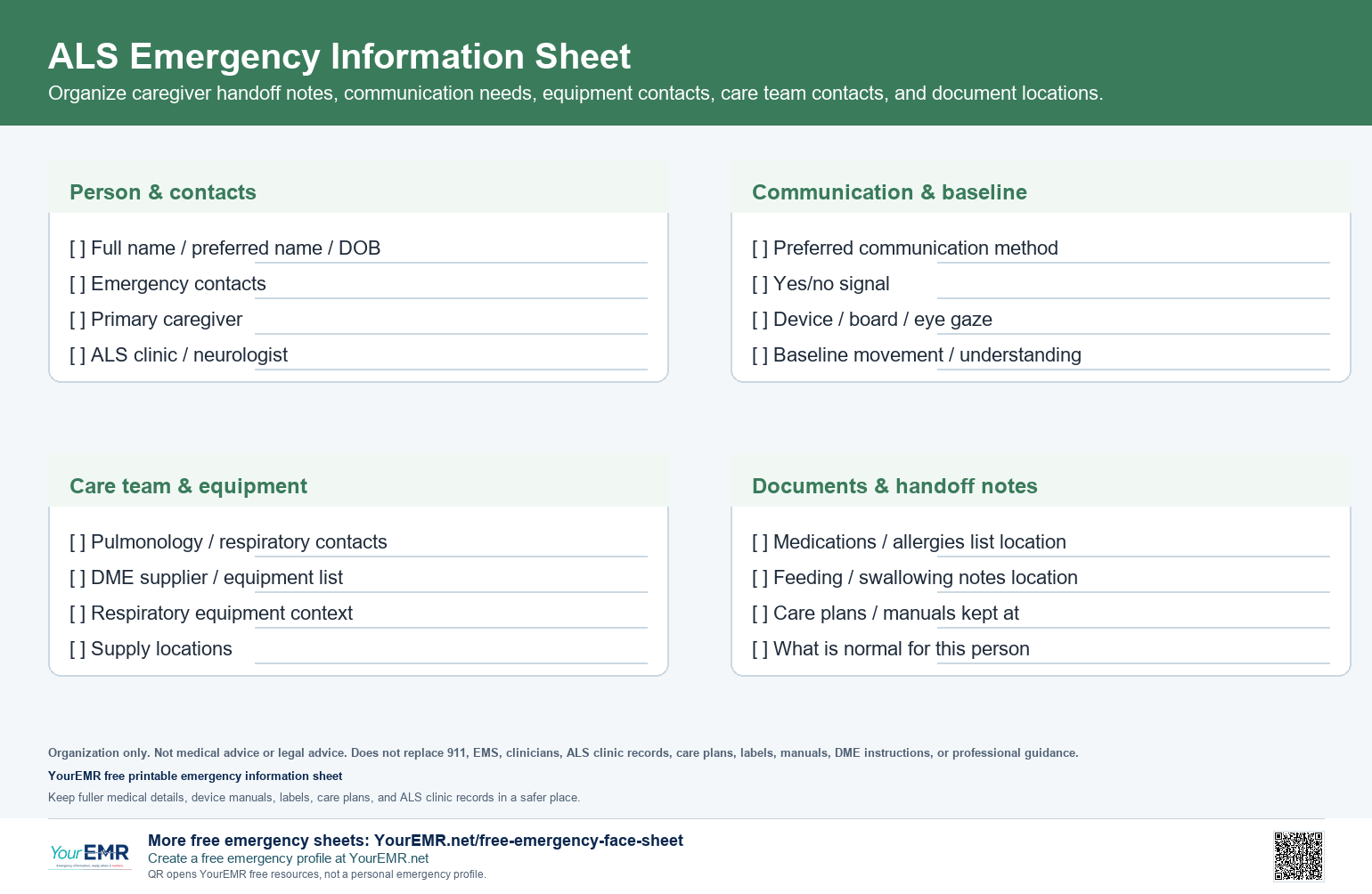
ALS emergency information sheet preview
Why this may matter in an emergency
ALS is a progressive motor neuron disease that can affect voluntary movement, speech, swallowing, and breathing. A person may understand what is happening but be unable to speak, gesture, write, or move easily.
Caregivers may not be present when information is needed, or a substitute caregiver may not know the current communication method, equipment contacts, medication list location, or care plan location.
A concise handoff sheet can help others find the right caregiver, clinic, supplier, document, or baseline context faster, without promising a specific outcome.
Where to keep it
Keep copies where trusted helpers know to look: emergency binder, refrigerator or visible home folder, go-bag, equipment bag, supply bag, primary caregiver folder, home health notes, respite caregiver notes, or a digital backup in YourEMR.
Do not assume every responder or helper will check one specific location. Tell trusted caregivers and family where the current copy and fuller documents are kept.
Who this ALS handoff sheet helps
This printable may help people living with ALS, family caregivers, spouse caregivers, adult children, home health aides, respite caregivers, and families preparing for ALS clinic, home health, hospital, or caregiver handoff situations.
It can be useful when communication, mobility, swallowing, breathing, equipment, supply, or caregiver contact details are changing and the family wants a calm place to keep the current handoff information.
Emergency handoff details to confirm
Before printing or sharing with a trusted helper, consider confirming that the most important contacts, locations, and source documents are current.
Confirm the person's preferred communication method, yes/no signal, baseline abilities, mobility or transfer context, and equipment context are current
Confirm caregiver, backup contact, ALS clinic, care team, home health, respite, pharmacy, DME supplier, and equipment or supply contacts are current
Confirm medication list, allergy list, respiratory equipment paperwork, swallowing or nutrition notes, care plans, manuals, labels, and document locations point to the latest records
Confirm the printed sheet, emergency binder, go-bag, equipment bag, supply folder, and digital backup locations are known to trusted caregivers and family
Keep the checklist factual and organizational; do not add device operation steps, treatment instructions, medication directions, triage instructions, or promises about outcomes
ALS handoff details to record
Helpful details may come from current labels, care team paperwork, device labels, supplier paperwork, caregiver notes, and contact lists. Keep the printable easy to scan.
Full name, preferred name, date of birth, emergency contacts, and primary caregiver
ALS clinic, neurologist, pulmonologist, respiratory therapist, speech therapist, dietitian, primary care, home health, pharmacy, and DME supplier contacts if applicable
Speech and communication notes, preferred communication method, yes/no signaling method, communication board, phone, tablet, speech device, or eye-gaze device if used
Mobility, transfer, baseline movement, equipment, supply, respiratory equipment, nutrition, swallowing, or feeding tube notes as caregiver-provided context only
Medication and allergy list, device and equipment list, current care plan location, device manual location, medication label location, patient portal location, and emergency document location
Baseline abilities and what is normal for this person, written as caregiver context rather than medical interpretation
ALS-specific handoff notes
ALS handoff notes can explain how to find current information and how the person communicates. Do not add device operation steps, ventilator settings, suction steps, feeding tube troubleshooting, medication directions, or emergency-response instructions.
Preferred communication method and yes/no signal, such as eye blink, thumb movement, facial movement, communication board, phone, tablet, speech device, or eye-gaze device
Baseline speech, movement, hand use, mobility, transfer support, fatigue, and positioning context as observed by the person or caregiver
Respiratory equipment, cough-assist, suction machine, BiPAP or noninvasive ventilation, ventilator, oxygen if applicable, supply, and DME contact information as context only
Feeding tube, swallowing, nutrition, formula, supply, or dietitian contact notes as context only, pointing to the current care plan or labels
What not to assume about cognition or understanding: speech or movement limits do not automatically mean the person does not understand
When to update it
Review the sheet when communication method, yes/no signaling, mobility, transfer support, respiratory equipment, DME supplier, feeding tube, nutrition, swallowing notes, medication list, allergy list, care team contacts, caregiver contacts, or document locations change.
It may also be worth reviewing after hospitalization, after a major care-plan change, when new equipment arrives, when a new caregiver starts, before travel, or on a simple regular schedule the family can remember.
Privacy and safety notes
Keep the sheet current and share it only with trusted caregivers, family, or helpers as appropriate. Avoid putting unnecessary sensitive details on a publicly visible printed sheet.
Keep fuller medical details, care plans, ventilator plans, feeding tube instructions, medication labels, device manuals, DME instructions, ALS clinic records, patient portal information, and legal documents in a safer place.
This page is for organization and emergency preparedness only. It is not medical advice or legal advice and does not replace 911, EMS, clinicians, ALS clinic records, medical records, medication labels, device manuals, ventilator plans, DME instructions, feeding-tube instructions, care plans, patient portals, or professional guidance.
Printable sheet versus digital YourEMR profile
A digital YourEMR profile may be easier to update and share when contacts, medications, equipment, baseline notes, or document locations change.
The printable QR footer opens YourEMR free resources. It does not open the person's personal emergency profile.
Helpful terms families may hear
ALS: Amyotrophic lateral sclerosis, a progressive motor neuron disease that can affect voluntary movement, speech, swallowing, and breathing.
Motor neuron disease: A term for disorders involving nerve cells that control voluntary muscle movement.
Caregiver handoff: Short notes that help another trusted helper find contacts, equipment, documents, and baseline context.
Communication board: A low-tech tool with letters, words, pictures, or choices that may support communication.
Eye-gaze device: A communication device controlled by eye movement.
Noninvasive ventilation / BiPAP: Respiratory support a person may use under a care plan; this sheet only records organizational context.
Cough assist: Equipment name families may see in a care plan or DME list; this sheet does not explain how to use it.
Suction machine: Equipment name families may see in a care plan or supply list; this sheet does not explain technique.
Feeding tube: A nutrition-related device or access point that may be listed with supply and care plan locations.
DME supplier: Durable medical equipment supplier or company contact for equipment and supplies.
Baseline ability: What is typical for this person, such as usual communication, movement, mobility, swallowing, or breathing context.
Information to gather about the person with ALS
Helpful details may include current communication needs, baseline abilities, mobility context, equipment context, and where fuller records are kept.
Preferred communication method, yes/no signal, communication board, phone, tablet, speech device, eye-gaze device, or other communication support
Baseline abilities, usual movement, hand use, mobility, transfer support, fatigue, positioning context, and what is normal for this person
Respiratory or equipment context such as BiPAP, noninvasive ventilation, ventilator, cough-assist, suction machine, oxygen if applicable, supplies, and DME contact information as organization only
Swallowing, nutrition, formula, feeding tube, supply, and dietitian contact notes as organization only, pointing to current labels, care plans, or records
Current medication list location, allergy list location, ALS clinic, neurologist, pulmonologist, respiratory therapist, speech therapist, dietitian, primary care, pharmacy, and patient portal details
Where current care plans, device manuals, supplier paperwork, medication labels, emergency documents, and legal documents are kept
Caregiver, family, and backup contact details to gather
Examples of details to gather, list, reference, or keep nearby include who knows the current information and where family, home health, respite, equipment, and emergency backup details are kept.
Primary caregiver, backup caregiver, spouse, adult child, trusted family, decision-maker contact if applicable, and who should be called first
Family handoff notes that explain where the most current information lives, who updates it, and who can confirm details if a helper is unsure
Home health, respite caregiver, ALS clinic, pharmacy, DME supplier, equipment supplier, supply company, and other support contacts
Where the emergency binder, go-bag, equipment bag, supply list, device manual folder, caregiver notes, and printed emergency information sheet are kept
When the family last reviewed communication, caregiver contacts, equipment contacts, medication and allergy list locations, supply locations, care plan locations, and document locations
Related YourEMR resources
Use these related YourEMR pages when they fit the person's situation.
suction machine checklist - Use when suction equipment, supplies, and DME contacts need their own page.
feeding tube sheet - Use when tube, nutrition, supply, and care plan locations need focus.
Helpful ALS caregiver and preparedness resources
These outside resources are for general education and preparedness only. They do not replace 911, EMS, clinicians, ALS clinic records, medical records, medication labels, device manuals, ventilator plans, DME instructions, feeding-tube instructions, care plans, patient portals, or professional guidance.
NIH information about ALS, motor neurons, progression, speech and communication support, nutrition, breathing support, multidisciplinary care, and caregiving context.
NIH/NLM information about personal health records, including emergency contacts, medicines, allergies, chronic diseases, and related health information.
This resource helps organize emergency information. It does not provide medical advice, diagnosis, treatment, or individualized emergency instructions.
These free sheets are informational organization tools only. They are not medical records, diagnosis tools, treatment plans, medical advice, or legal advice, and they do not replace 911, EMS, clinicians, medical records, medication labels, device manuals, care plans, patient portals, or professional guidance.