For sharing critical airway details quickly
Emergency Information Sheet
Use this printable to document trach size, backup airway details, oxygen/suction/ventilator notes, DME contacts, providers, medications, allergies, and emergency contacts.

Free printable emergency information sheet
Use this trach and airway handoff sheet to keep airway status, emergency airway bag location, suction supply location, equipment and DME contacts, ENT or pulmonology contacts, and care-plan document locations easy to find.
Ideal for a home, school, travel, or caregiver binder. For all ages. Ask the care team how often to review.
This may be called a trach emergency sheet, airway handoff sheet, suction supply organizer, caregiver airway sheet, or face sheet in some healthcare settings.
No signup is required to download the printable PDFs.
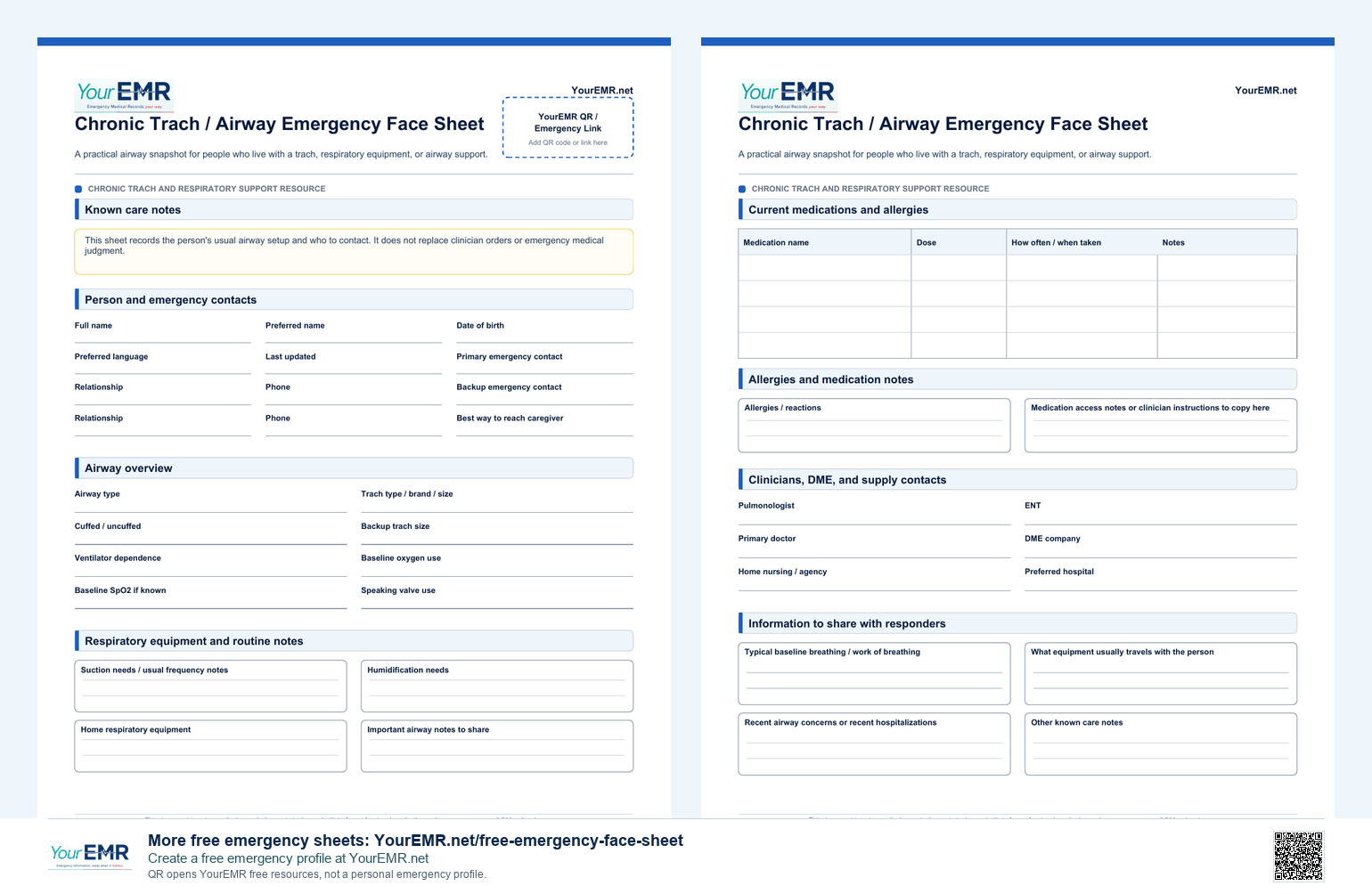
One printable helps caregivers communicate essential airway information. The other helps families organize the supplies that may need to stay with the person.
For sharing critical airway details quickly
Use this printable to document trach size, backup airway details, oxygen/suction/ventilator notes, DME contacts, providers, medications, allergies, and emergency contacts.
For organizing the trach kit and suction go-bag
Use this checklist to track replacement trachs, suction catheters, tubing, canisters, gauze, ties, DME contacts, and monthly kit checks.
Both printables are free to download. No signup required.
Emergency supplies
A written emergency sheet is helpful, but caregivers also need supplies nearby. This checklist section is meant to help families ask better questions, organize supplies, and review the kit with the care team.
Always follow the person's care plan and review supplies with the ENT, pulmonology team, respiratory therapy team, home nursing team, or DME provider.
Keep a copy of the emergency information sheet or a summary card with the kit.
Printable checklist
Use the go-bag checklist to review supplies, check what is missing, and keep emergency equipment organized near the airway bag, suction machine, school bag, travel bag, or caregiver binder.
This checklist is for organization only. It is not medical advice, a treatment plan, or a guarantee of insurance coverage.
Supply coverage rules do not always match emergency-readiness needs. Medicare, Medicaid, private insurance, and DME supplier rules may limit how often certain items are replaced. Families who cannot maintain a safe backup supply may need to ask the clinician, ENT, pulmonology team, respiratory therapy team, or DME provider about updated documentation, a written order, or a letter of medical necessity. This section is for general information only and is not a guarantee of coverage, medical necessity, or DME approval.
These examples can help families gather airway status, supply locations, contacts, and care-plan locations without turning the page into trach care instructions.
This sheet can help people who have a chronic tracheostomy, parents caring for a child with a trach, caregivers helping someone with airway equipment, people who use oxygen or suction, and families managing ventilator or respiratory equipment at home, school, during travel, or during care handoffs.
For a less airway-specific option, see the general emergency information sheet. Parents organizing broader medical needs may also want the medically complex child sheet.
Need a different airway-related sheet? See the laryngectomy / neck breather emergency information sheet.
Trach and airway details can be hard for a substitute caregiver, transport team, school contact, or family member to reconstruct from memory. The person may have supplies in one place, equipment contacts in another, and care instructions stored with home nursing notes or device paperwork.
A concise sheet can point trusted helpers toward the current airway status, backup supply location, equipment supplier, respiratory or ENT contacts, and care-plan documents without trying to teach trach care or emergency treatment.
Helpful details may include airway status, trach or backup trach information if listed in current records, oxygen or suction context, equipment and supply locations, DME company contacts, pulmonology, ENT, respiratory therapy, medication-list location, allergies, baseline breathing context, ventilator document location if used, and caregiver contacts. Keep ventilator information organization-only by pointing to clinician, respiratory therapy, or DME records instead of writing operating steps.
Keep a copy somewhere easy to find, such as with the emergency airway bag, near the bed, near suction equipment, in a caregiver binder, in a school or travel packet, with home nursing instructions, or with a trusted family member. A copy may also be useful for respite care, transport, appointments, or emergency planning.
Review it when trach type or size, backup trach size, cuff status, oxygen or suction context, ventilator or speaking-valve information, DME contacts, pulmonology or ENT contacts, medications, allergies, supply locations, or care-plan location changes.
Keep this page factual and organizational. Do not use it for trach care steps, suction technique, ventilator adjustments, oxygen changes, medication directions, or emergency-response instructions. If ventilator information is relevant, point to the current care plan, device paperwork, and care-team contact rather than rewriting operating details. Do not change ventilator, oxygen, or suction settings based on this sheet. Always follow the person's care plan and contact the care team or emergency services when there is a concern.
Families and caregivers may hear words like tracheostomy, trach tube, stoma, inner cannula, obturator, cuff, pilot balloon, cuffed or cuffless tube, backup trach, suction, humidification, HME, oxygen, ventilator, ventilator plan location, speaking valve, Passy-Muir valve, trach ties, dressing, DME, ENT, pulmonology, respiratory therapist, speech-language pathologist, pulse oximeter, secretions, and emergency bag. The printable can point trusted helpers toward the terms, contacts, supply locations, and care-plan locations that apply to the person's actual care.
A printable sheet is a useful backup, especially for airway information that needs to be found quickly. An updateable YourEMR profile can work alongside paper when contacts, equipment notes, and document locations change often.
These outside resources are for general education only. Always follow the care plan and emergency instructions from the person's medical team.
Plain-language patient education about tracheostomy care.
Overview of what a tracheostomy is and why someone may need one.
Patient education about tracheostomy, ventilators, suctioning, and related risks.
Patient education about living with a trach, speaking, eating, and home planning.
Professional information about communication, swallowing, ventilators, and speaking valves.
Safety-focused information about speaking valves and ventilators.
Plain-language guide explaining trach parts such as cuff, pilot balloon, inner cannula, obturator, and trach ties.
Manufacturer instructions for Passy-Muir speaking valves. Use only as directed by the care team.
These resources informed the emergency kit, suction supply, and DME coverage-limit information on this page. Always follow the person's care plan and review supplies with their care team.
Continue with guidance and printables already grouped for this topic.
Content accountability
This resource helps organize emergency information. It does not provide medical advice, diagnosis, treatment, or individualized emergency instructions.
No individual medical review is claimed.
Editorial standards and correctionsSend individual feedback or report a correction
Ready for an updateable profile?
YourEMR helps keep emergency information organized and ready when it matters.
These free sheets are informational organization tools only. They are not medical records, diagnosis tools, treatment plans, medical advice, or legal advice, and they do not replace 911, EMS, clinicians, medical records, medication labels, device manuals, care plans, patient portals, or professional guidance.